
Good Start Solar Case Study
Every type of business is now embracing solar energy in a big way.
Whatever the needs of your business, whether your electricity is single-phase or three-phase, from small consumption to huge consumption needs, solar PV can be made to fit your your business case.
This is the new realisation for business owners and managers.
Some people may still struggle to recognise that you can run a large automated factory on solar PV.
Such case studies are widely available in industry magazines where, from heavy industry to horticulture, solar PV is filling the need for cost-effective energy production.
Case Study: A Progressive Factory
The factory in question is moderately large, employs a significant number of people, and is owned by a larger company producing a range of products.
Having implemented a modest size solar array a number of years ago, the factory would be considered an early adopter in solar energy, and would be similarly progressive in their core business activity which is a successful enterprise.
Up to recently we estimate the factory have invested over €1 million in solar modules which are making a huge contribution to the factory’s energy needs over course of a year.
Before we get carried away on the size of the investment we should mention that €1 million is a small sum of money to this particular business, and in any case the business receives generous tax breaks allowing them to write-off the investment against their tax liability.
Essentially tax-payers are underwriting this solar PV investment.
The Solar Array
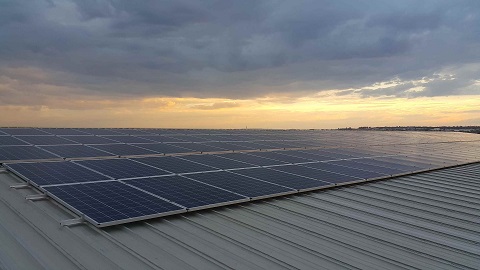
The solar array itself faces almost due South, which is often the optimum azimuth for a fixed-array in the Northern hemisphere.
The tilt angle however leaves a lot to be desired.
Essentially no actions were taken regarding the tilt angle and the solar array, composed of several hundred solar modules, was simply clamped onto the roof as it stood.
The tilt-angle for a twenty to thirty-year solar project being solely defined by the choice and tilt-angle of the roof that was constructed twenty years ago.
By the time all the cabling had been routed to the plant-room the installing company ran out of steam and had to bring in outside advisers to complete and energise the system.
In fact the installing company didn’t fit the solar modules either, rather this was insourced to the customer who had a lot of skilled labour on-site.
The installers did rather well for themselves out of the deal, mainly occupying a supply-side role with an advisory capacity tagged on.
A More Positive Outcome
Well done to the installers though for selecting Tier 1 modules and power electronics components from large well established manufacturers, both of which offer reasonable warranty terms.
In terms of optimising the array, there are positives and less positives.
– Quality components are good.
– South-facing array is good.
– Tilt angle could be improved.
We estimated that the factory is producing on average ~ 700,000 kWh per annum, which is saving a minimum of €330,000 per year on electricity costs when self-consumption is 100% (as there is a “no export” agreement in place with the network operator).
When the year-to-year variability is +/- 5%, the production range is ~665,000 kWh to 735,000 kWh per annum.
However we also estimated that at optimum tilt and azimuth the same solar array could in fact produce on average ~ 750,000 kWh per annum with annual variability of +/- 37,500 kWh (+/- 5%).
The annual output could have been in the range 712,500 kWh to 787,500 kWh, potentially saving up to €393,000 per annum on electricity costs.
It’s not a cash issue here as the factory would barely notice the absence of €63,000/year, rather we would say that an amount of electricity up to 122,500 kWh/year now needs to be produced by the grid, and drawn from the grid, at an annual expense to both the factory and taxpayers.
Over the twenty to thirty-year life of the project these figures quickly accumulate.
A few more hours spent optimising the array, or providing the customer with options for costing a more suitable mounting system would have improved the installation in our view.
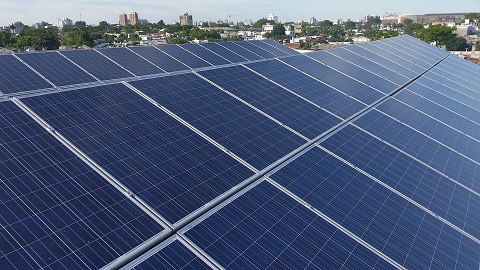
At optimum tilt and azimuth the same solar array could have potentially saved an extra €63,000 per annum for the factory
The Summary
The summary is that even if you have deployed lots of solar which is producing significant amounts of electricity for your factory, you could have done better!
Casual omissions, like optimising the tilt-angle, when multiplied across several sites, or hundreds of customers, leaves a large gaping hole in the national grid requirement.
Don’t rest on your laurels.
By engaging a solar engineer the factory could have improved their level of technical awareness in solar energy.
It’s a good start, let’s do better next time!
Contact Us to improve the outcome for your solar array!
Solar Now (c) All Rights Reserved